
Limiting global warming to under 2°C will require immediate emission cuts. But, because these cuts are currently not occurring (or at least not fast enough), humankind will also need to remove some of the excess CO2 that has been emitted over the last ~100 years from the atmosphere and store it in a safe carbon reservoir. The dependence of the "less than 2°C target" on so-called atmospheric CO2 removal increases the longer CO2 emissions continue. The IPCC estimates that CO2 removal needs to reach about 5-10 billion tonnes CO2 per year by 2050. For comparison, current CO2 emissions are 40 billion tonnes per year. Forests are already helping with CO2 removal by taking up about 2 billion tonnes per year. But forests won't do much more than that, so humankind needs to identify other ways to remove carbon to eventually reach 10 billion tonnes per year.
One widely considered pathway involves the ocean. The weathering of "alkaline" rocks such as basalt or limestone converts CO2 dissolved in water into bicarbonate ions, which is a stable form of carbon that remains in seawater for thousands of years. This weathering is a very slow natural response to increased atmospheric CO2, which will sequester the CO2 humankind has added to the atmosphere over the next 100,000 thousand years. Ocean alkalinity enhancement (OAE) aims to accelerate this process, by increasing the exposure of alkaline rocks to seawater. The geochemical reactions that drive OAE are well understood. However, important questions remain about its effectiveness and environmental implications.
Independent research is essential to evaluate OAE objectively, using laboratory and field research as well as computer simulations. Our research team at the Institute for Marine and Antarctic (University of Tasmania) has focussed on OAE research since 2019. We began in the lab, progressively increasing the complexity of our research. In 2024, we launched a very small-scale field study in Southern Tasmania, distributing ~4 kg of limestone and "serpentine" powder (serpentine is an alkaline volcanic rock) over 6 m2, respectively. The goal was to investigate how anticipated geochemical reactions function in natural sandy sediments and how it effects organisms that live there (link to prior study).
This study gave us two key insights. Firstly, that smaller scale field studies provide key insights into the feasibility and effects of OAE. And secondly, to more accurately assess the effectiveness and biological effects of OAE we needed to moderately increase the size of study area to better reflect real-world conditions (because key organisms such as seagrasses extend beyond the size of our first very small-scale field study). Building on these insights, we increased the combined size of our field plots in the 2026 study from 6 m2 to 450 m2. Furthermore, we have chosen to work within an organic-rich system (a seagrass bed) and focus solely on limestone, an OAE pathway referred to as "coastal liming".
Coastal liming is the purposeful addition of limestone, or calcium carbonate (CaCO3), onto high organic coastal sediments to increase alkalinity. Limestone is a potentially useful alkaline material for ocean alkalinity enhancement as it has very few impurities, is cheap and widely available. When added to acidic environments, such as high organic ocean sediments, the limestone dissolves and releases calcium (Ca2+) and carbonate ions (CO2-3) from CaCO3. The carbonate ion can buffer protons (it elevates pH), thereby reducing acidity and converting CO2 in seawater into bicarbonate ions (HCO-3). The conversion of CO2 into bicarbonate allows more CO2 from the atmosphere to be absorbed by the ocean, which drives the desired carbon dioxide removal.
Coastal liming has its roots in the terrestrial practice of agricultural liming, whereby limestone is added to crops to reduce soil acidity and enhance crop yields. Hence, the motivation behind investigating coastal liming in a seagrass bed is two-fold. Firstly, we are interested in its potential to enhance carbon dioxide removal and secondly, we are interested in whether it can benefit seagrass communities. Our goal is to provide real-world evidence on suitability of limestone as an alkalinity source in coastal environments.
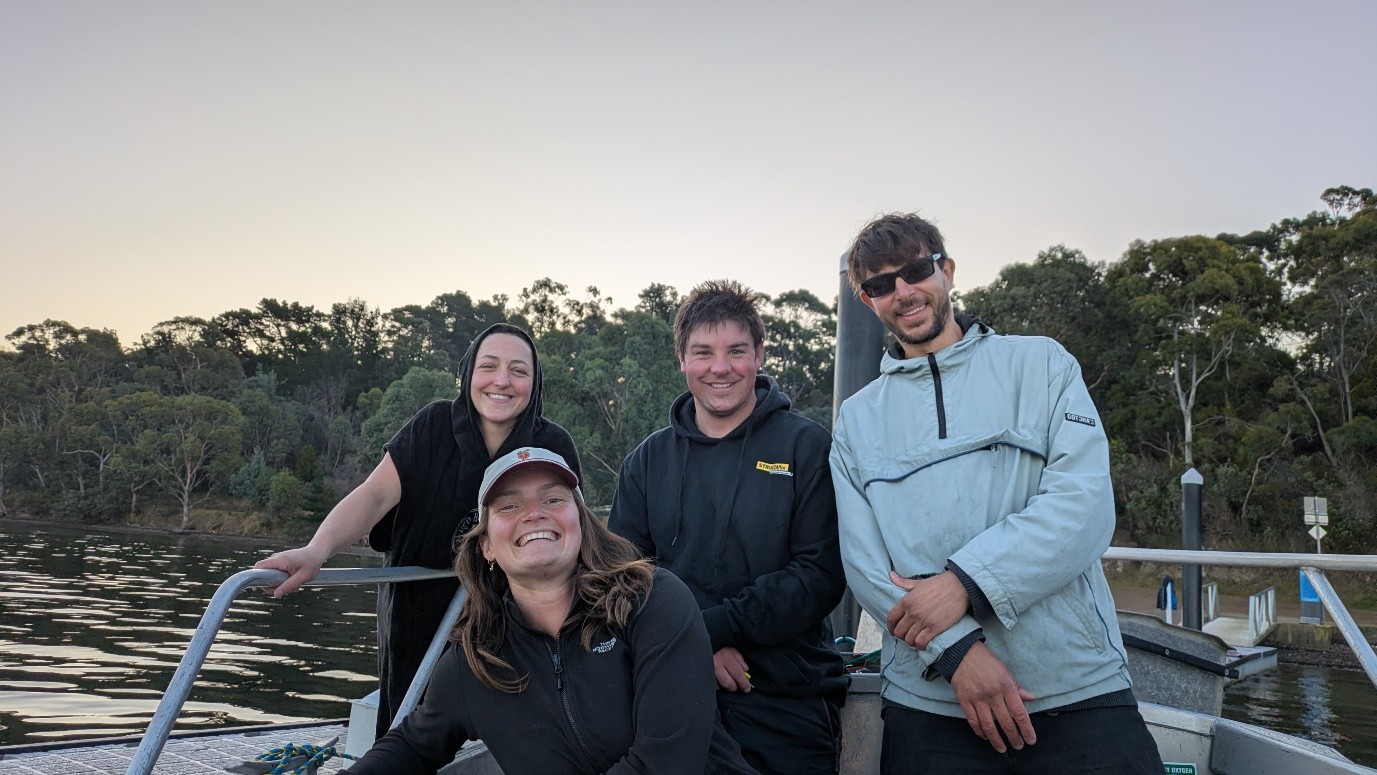
The planning for the study began shortly after concluding our 2024 field study. The practical work began in austral autumn 2026, in an estuary in south-east Tasmania. This blog will document our study and inform on what we observed.