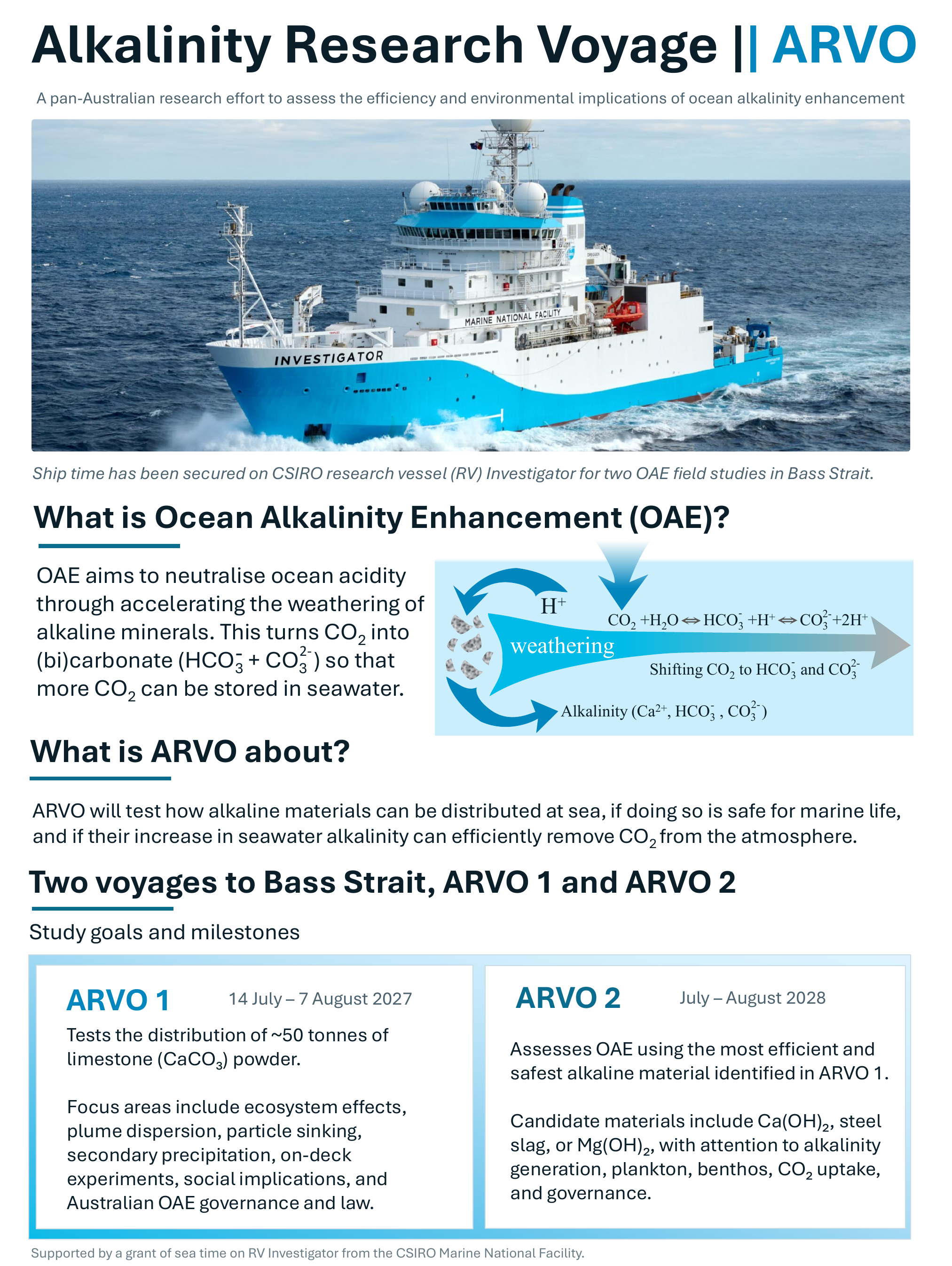
Alkalinity Research Voyage || ARVO
The Alkalinity Research Voyage is a pan-Australian effort preparing two ocean alkalinity enhancement field studies.
FAQ
Frequently asked questions
What is ARVO and ocean alkalinity enhancement?
What is the Alkalinity Research Voyage (ARVO)?
The Alkalinity Research Voyage (ARVO) is a scientific research initiative focused on ocean liming, a form of ocean alkalinity enhancement (OAE). Through two research voyages with CSIRO research vessel (RV) Investigator in Bass Strait, ARVO aims to improve understanding of the effectiveness and environmental implications of this approach in Australian waters.
What is ocean alkalinity enhancement (OAE)?
Ocean alkalinity enhancement (OAE) refers to a group of novel CO2 removal pathways that aim to increase the ocean's capacity to absorb and store atmospheric CO2 by adding alkaline materials to seawater. These approaches seek to accelerate natural weathering processes that already help regulate Earth's climate.
What is ocean liming?
Ocean liming is one form of ocean alkalinity enhancement whereby particulate minerals derived from limestone are added to the ocean to increase alkalinity. Analogous to the long-established practice of agricultural liming on land, the addition of lime neutralises seawater acidity to enable storage of additional CO2 in seawater.
Why we focus on ocean liming?
We focus on lime as a source of alkalinity because limestone contains hardly any other bioactive elements like trace metals or nutrients. It is therefore considered among the safest alkaline materials for ocean alkalinity enhancement.
Why study carbon dioxide removal?
Why is ARVO studying carbon dioxide removal (CDR)?
Scientific and policy assessments indicate that carbon dioxide removal (CDR) is likely to be needed alongside emissions reductions to help address climate change and counteract hard-to-abate residual emissions. ARVO contributes to this broader scientific effort by evaluating one potential marine carbon removal approach.
Is carbon dioxide removal (CDR) the same as carbon capture & storage (CCS)?
No. CDR is fundamentally different to CCS. Carbon dioxide removal (CDR) aims to remove CO2 from the atmosphere and store it in another carbon reservoir. The most common form of CDR is afforestation, which aims to store CO2 in trees and forests. CCS takes CO2 from a point source, for example a coal power plant, before it enters the atmosphere and stores the captured CO2 underground.
Does ARVO see carbon removal as a substitute for emissions reductions?
No. Emissions reductions remain the most important and effective response to climate change. Carbon dioxide removal can only play a complementary role, needed for keeping global warming below 2°C because humans have already emitted too much carbon into the atmosphere. ARVO's research is focused on understanding whether ocean liming could contribute to carbon removal alongside rapid and sustained emissions reductions.
Why is there interest in novel forms of carbon dioxide removal?
Reaching high amounts of carbon removal will require a portfolio of methods. Conventional CDR approaches, such as forestry, are critical components to this portfolio but cannot provide enough and store carbon only short-term. Due to these limitations, there is growing international interest in novel CDR approaches that could complement conventional methods.
How will the voyages work?
Will the first voyage (ARVO 1) lead to ocean liming?
No. ARVO1 will use limestone (CaCO3) which does not readily dissolve in seawater. About 80% of the seafloor at Bass Strait is CaCO3. The purpose of ARVO 1 is to test our delivery system and limestone dispersion. Furthermore, we do contained experiments on the deck of RV Investigator with more reactive lime (e.g. portlandite, Ca(OH)2) to assess if these could be used safely for the second voyage, ARVO 2.
Will the second voyage (ARVO 2) lead to ocean liming?
Maybe. If shipboard experiments during ARVO 1 find Ocean Liming to be without risk for the marine environment, we may add more reactive lime (e.g. portlandite, Ca(OH)2) during ARVO2. In that case, the intention is that lime dissolves in the surface ocean to neutralise acidity, elevate alkalinity, and absorb atmospheric CO2, without negative effect on the plankton community.
How do we assess the "environmental risk"
ARVO will apply state-of-the-art methodology including experimental incubations, natural analogue studies, and modelling to establish (1) if and how ocean liming affects marine communities, (2) if effects are observed, which organisms are "winners" and which ones are "losers" (3) implement findings into numerical simulations to assess wider environmental risks.
Why is further research needed?
Laboratory studies, modelling and small-scale field research have improved understanding of ocean liming and other OAE approaches. However, larger-scale open-ocean research is needed to understand their effectiveness and environmental implications under more realistic conditions.
Why is the study being conducted in Bass Strait?
Bass Strait was selected for scientific and logistical reasons. Its relatively shallow waters, proximity to land and operational accessibility make it a suitable environment for studying ocean liming under realistic ocean conditions.
Purpose, independence, and decision-making
Why was ARVO proposed?
ARVO was developed in response to growing recognition by governments and international organisations that carbon dioxide removal may be needed, alongside emissions reductions, to help achieve global and Australian climate objectives. The project aims to provide independent scientific evidence to support informed decision-making.
What is the purpose of the ARVO study?
ARVO aims to generate scientific evidence on the effectiveness and ecological effects of ocean liming. This evidence can help inform future decisions about whether the approach should be considered further or ruled out.
Does ARVO support deploying ocean liming in Bass Strait?
No. The selection of Bass Strait does not imply support for future deployment in the region. The location was chosen solely on the basis of scientific and logistical considerations for conducting the research.
Why is independent research important?
Interest in ocean alkalinity enhancement is growing among governments, researchers and private companies. Independent academic research plays an important role in evaluating effectiveness, quantifying carbon removal, assessing environmental impacts and providing evidence that supports informed public and policy discussions.
Does ARVO advocate for OAE?
No. ARVO is a scientific research project. The research team is studying ocean liming to assess its geochemical performance and environmental implications. The project is entirely neutral. It does not advocate for, or oppose, future deployment.
Has ARVO already decided whether OAE should be deployed?
No. ARVO remains neutral on whether ocean liming or other OAE approaches should ultimately be deployed. Consistent with a precautionary scientific approach, the research is designed to rigorously test whether the method is effective and environmentally acceptable under realistic ocean conditions.
Communication, stakeholders, and support
How does ARVO approach communication and engagement?
ARVO aims to build knowledge and trust through a commitment to neutrality, authenticity and transparency. Project communications focus on clearly explaining the purpose, methods, findings and limitations of the research, while ensuring that scientific evidence remains at the centre of discussions about OAE.
What role do stakeholders and the public play?
Scientific research benefits from engagement with stakeholders and the broader community. ARVO aims to provide accessible, evidence-based information that supports informed dialogue about marine carbon dioxide removal and its potential role in addressing climate change.
Who funds ARVO?
This research is supported by grants of sea time on RV Investigator from the CSIRO Marine National Facility.
ARVO team
Meet the scientists behind ARVO
The ARVO team brings together researchers working across marine biology, chemistry, physics, geology, social sciences, and law.
News and updates
Stay up to date with ARVO
Short updates will document planning, voyage preparation, field work, and early observations as the project develops.
Flyer