
Blog post 1
What is ARVO?
15 July 2026 | By Lennart Bach and Zanna Chase
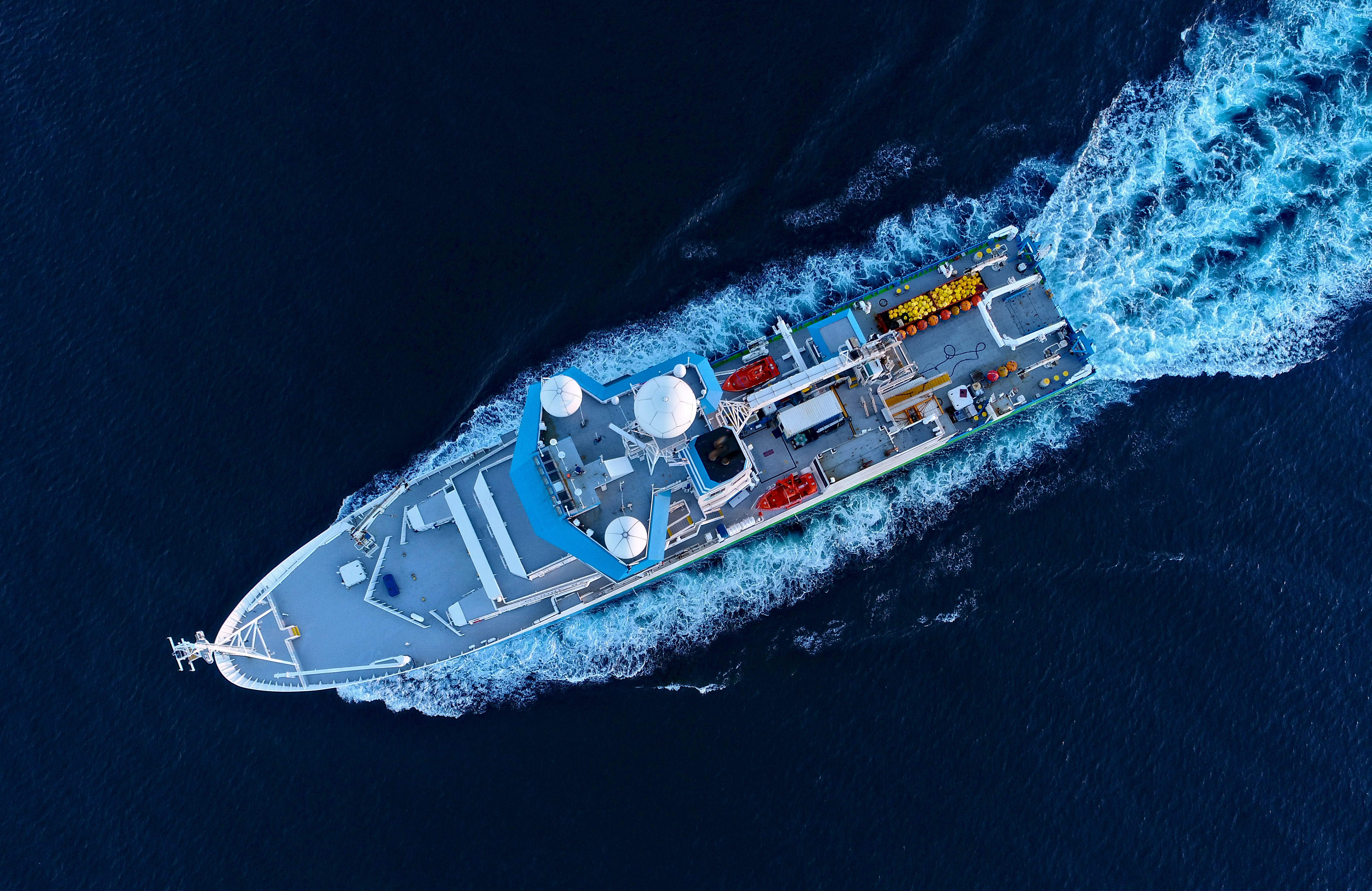
In early 2026, the CSIRO Marine National Facility awarded our team ship-time on research vessel (RV) Investigator. The project will investigate whether adding alkaline minerals to the ocean can help it store more carbon dioxide (CO2) from the atmosphere and if/how it could affect the ocean environment. In 2027 and 2028, a pan-Australian research effort will run two voyages to Bass Strait. Building on several years of laboratory, modelling and small-scale field studies, the two Alkalinity Research Voyages (ARVO I and II) aim to determine whether this approach, known as “ocean liming”, is worth considering further.
Could “ocean liming” support Australia’s carbon mitigation efforts?
In principle, the idea is simple. Farmers have long added lime to soils to counteract acidification and improve soil quality. Similarly, adding alkaline minerals to seawater could neutralize acidity, helping the ocean absorb more CO2 from the atmosphere. However, whether coastal liming works effectively, and whether it has unintended impacts on marine ecosystems, requires further research.
Cutting emissions must come first
Before considering CO2 removal, one point must be clear: cutting emissions is far more important and effective. Carbon dioxide removal (CDR) can only ever play a supporting role. Even in optimistic scenarios, removing CO2 is slower, more expensive and more uncertain than avoiding emissions in the first place. If global emissions are not reduced rapidly, carbon removal will not keep up. However, most pathways to limit global warming now assume that several billion tonnes of carbon removal per year, or about 10% of our current emissions, is unavoidable to keep global warming below 2°C.
What is ocean alkalinity enhancement?
Alkalinity is composed of a range of buffering substances that collectively determine how much CO2 can be stored in seawater without acidifying. Alkalinity is generated very slowly through the weathering of rocks, and has been transported to the ocean naturally throughout Earth’s history. When materials such as limestone dissolve in seawater, they convert dissolved CO2 into bicarbonate - a stable form of carbon that remains in the ocean for thousands of years. Without alkalinity in the ocean, Earth’s climate would be roughly 200-300 degrees hotter.
Ocean alkalinity enhancement (OAE) refers to a range of more than 50 pathways like ocean liming. These pathways differ widely but they have one thing in common: all of them aim to increase the ocean’s capacity to store carbon by adding alkaline materials. In essence, OAE aims to accelerate the otherwise very slow process of rock weathering to sequester additional carbon in the ocean.
Coastal liming - the subject of ARVO - is one specific form of OAE pathway, where lime is used as a source of alkalinity.
Potentially useful, but highly uncertain
OAE has some appealing features. In theory, it could provide long-term carbon storage without directly manipulating marine ecosystems. However, the approach is potentially expensive, lacks clear regulation, and can induce feedbacks that reduce its efficiency. Scaling it up would also require mining and transporting large amounts of alkaline material. And, most critically, adding alkaline substances to the ocean could have ecological effects.
At present, it is unclear whether OAE can be done safely and efficiently. For this reason, our cautious research hypothesis is that it may not work. This avoids unrealistic expectations and keeps the focus on emissions reduction. If OAE proves viable, that would be a positive outcome. But there is a real chance it will not.
Why independent research matters
Interest in OAE is growing, including from start-ups developing carbon removal methods. These efforts are valuable. They address practical questions and generate useful early data. But independent academic research remains essential, especially to assess environmental risks and confirm precisely how much carbon removal actually occurs. Such scrutiny has been crucial for earlier marine carbon removal ideas, such as iron fertilisation, where initial optimism did not hold up after academic research investigated them more thoroughly.
A paradox: simplicity may be an advantage
Many people find biological carbon removal approaches, such as enhancing plankton growth or seaweed farming, more appealing because they seem more “natural”. Paradoxically, OAE’s potential lies in not relying on biology. Ocean ecosystems are complex and difficult to control. By contrast, the chemistry underpinning OAE is well understood. This relative simplicity may make outcomes more predictable.
OAE also offers long-term storage, while biological systems do not. Carbon converted to bicarbonate can remain in the ocean for tens of thousands of years. This is far longer than storage in biological systems such as forests, where disturbances like bushfires can quickly return carbon to the atmosphere.
Next step: the ARVO voyages
To better understand OAE in real conditions, we developed the Alkalinity Research Voyage (ARVO). For ARVO, we will conduct two voyages on RV Investigator to Bass Strait in winter 2027 and 2028.
During the 2027 voyage we will disperse around 50 tonnes of limestone sand (calcium carbonate, CaCO3) to test our distribution system and study how the plume behaves in the water column. We chose limestone since the Bass Strait sediment is >80% calcium carbonate, meaning this rather inert material cannot affect the environment. On deck, we will incubate organisms from the area to gain insights into how more reactive alkaline materials like lime (Ca(OH)2) could affect these communities.
The safest and most effective material will then be used for dispersion in 2028, but only if environmental risks of this dispersal can plausibly be ruled out. The goal of the 2028 voyage is to understand if/how organisms respond and carbon is sequestered under realistic ocean conditions.
What we hope to learn
Earlier lab and small-scale field studies suggest coastal liming may work. However, the open ocean is far more complex and we aim to understand if the approach would work under more realistic deployment conditions. Equally important is understanding local environmental effects and how these compare to the benefits of sequestering carbon. Independent data from Australian waters will help inform public debate and policy decisions about whether such approaches should ever be used.
A cautious conclusion
So, is ocean alkalinity enhancement desirable? In a world where carbon removal was unnecessary, the answer would be no. But given the scale of climate change and the need for large amounts of carbon removal, the question becomes more nuanced. Could OAE make a useful contribution? There is a chance it may, and that is what we aim to figure out.
This research is supported by grants of sea time on RV Investigator from the CSIRO Marine National Facility.