
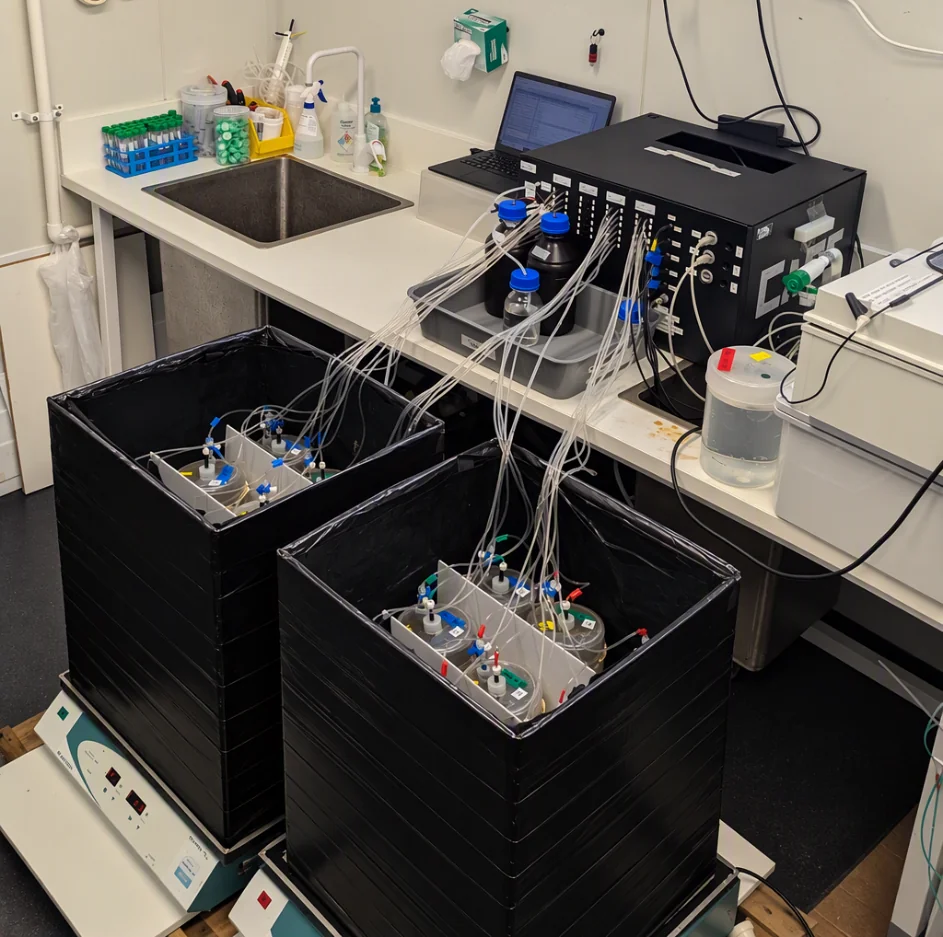
Many factors influence how limestone dissolves in coastal sediments. As organic matter breaks down, it can make porewaters more acidic and speed up dissolution. Physical mixing by waves and currents can transport oxygen and dissolved chemicals through sediments, while burrowing animals and other organisms create a form of biological mixing that can have similar effects. Sediment grain size also plays an important role by determining how much water is held within the sediment and how easily that water can move through it. Because all of these factors operate simultaneously in natural environments, it is difficult to determine their individual contributions to limestone dissolution. Laboratory experiments allow me to isolate and test each factor individually.
To do this, I developed a sampling system that can monitor carbonate chemistry in both the overlying water and sediment porewater across 18 incubators at once.
The incubators
The system is built around the incubators, which each can hold 4 to 5 liters. They have a rigid base and a collapsible upper body, so the walls fold inward as water is sampled, with no head space or negative pressure issues. Each incubator has a sediment layer of 4 to 5 cm depth, and is then topped up with seawater. There is tubing that samples sediment porewaters, and a rigid tube that samples the water column. This allows me to see how chemical changes in the sediment carry over to the overlying water column.
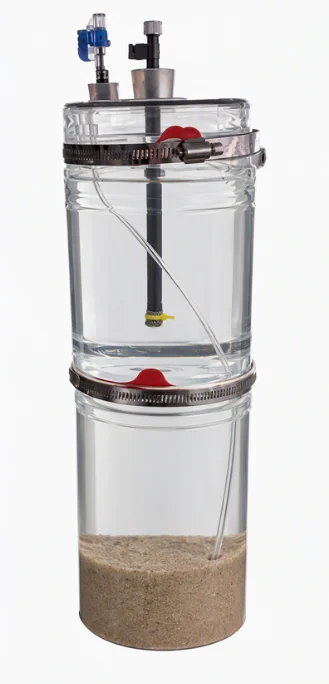
The incubators are placed in custom-made boxes to keep them upright as water is removed. Each incubator is connected to the C-SWAPS system via Tygon tubing.
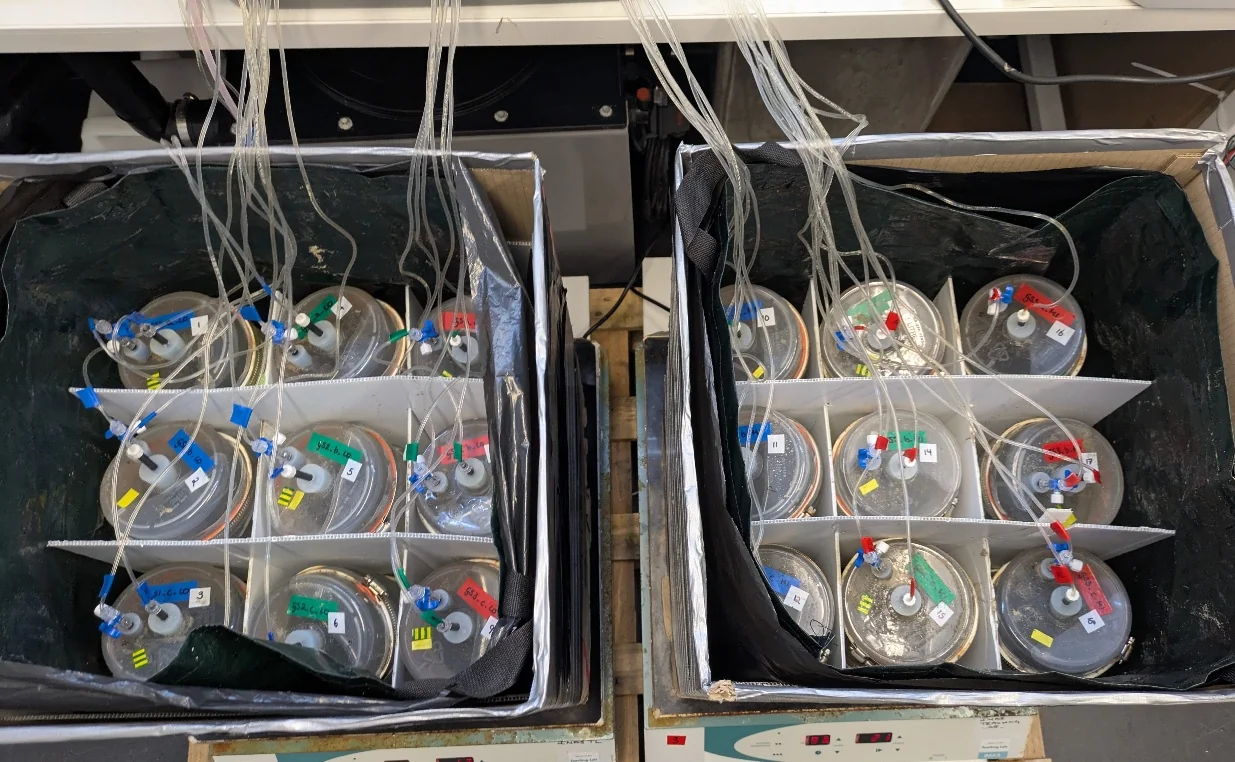
The C-SWAPS system
The Carbonate System Water And Porewater Sampling System (C-SWAPS) is the control centre of the setup. It is an automated platform that draws water out of the incubators, allowing me to measure pH around the clock. The design is adapted from McGraw et al. (2010), and I upgraded it to measure pH in both the water column and the sediment porewater.
Each of the 36 inlets (two per incubator) is connected by tubing to a programmable syringe pump with rotary valves. The pump draws water from each inlet in turn, slowly enough to avoid disturbing the sediment, and sends it to a measurement cell where pH is analysed. Automating this means all 18 incubators can be sampled several times a day, which would be impractical by hand. The same pump is also used for the discrete samples I collect manually.
What do I measure?
The pH measurement works like a litmus test but far more precise. Each sample is pumped through a flow-through cuvette, where an indicator dye is added. The dye changes colour with pH, and a spectrometer measures how much light the sample absorbs, which gives the pH. This happens automatically every 6 hours in both the water column and the porewater.
A single dye can't cover the full pH range in these incubators, so I use two. Meta-cresol purple (mCP, ~6.8 to ~8.7) is used for the water column, where pH is higher. Phenol red (PR, ~5.9 to ~7.7) is used for the sediment porewater, where pH is lower. Together they cover ~5.9 to ~8.5.
I also collect discrete samples manually for dissolved oxygen, total alkalinity and dissolved nutrients.
Each experiment runs for five days, and total sampling removes less than 20% of the incubator volume, so the system stays close to undisturbed.
Variables
I have done experiments on both artificial and natural sediments. So far I have varied:
- Mixing rate: using the shaker tables
- Organic matter loading: by adding shredded kelp
- Grain size
- Limestone placement: sprinkled on the sediment surface vs mixed through the sediment
- Bioturbation: adding burrowing animals such as worms, which mix and irrigate the sediment