
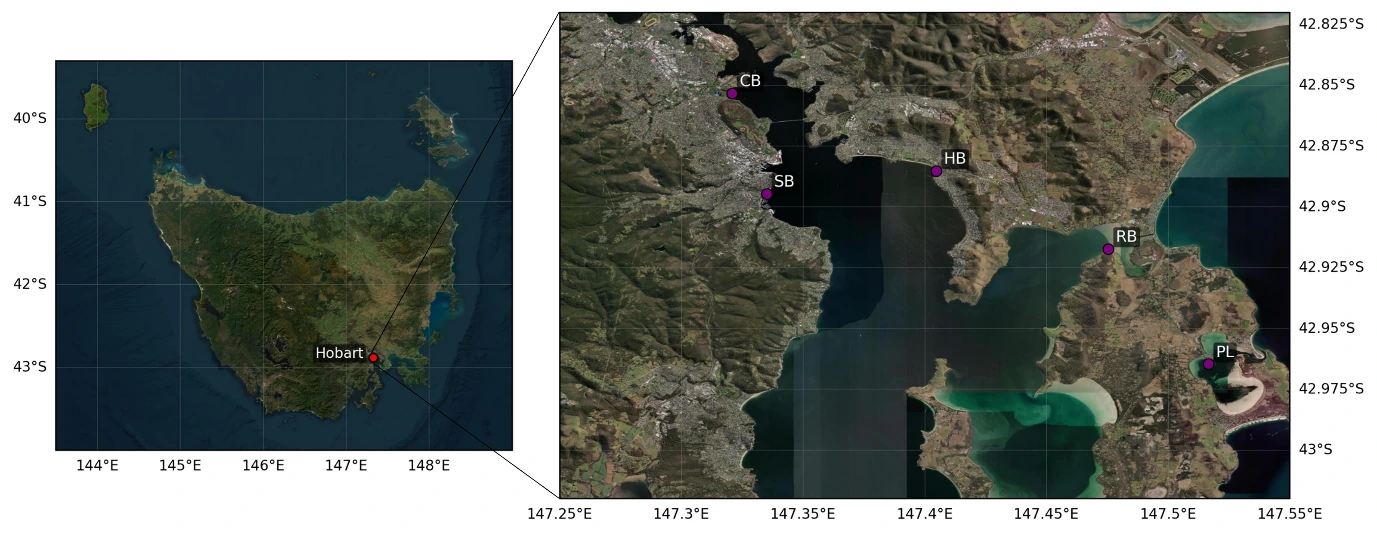
Five subtidal coastal sites were selected along the Derwent Estuary and South Arm in the Hobart region, Tasmania. See the figure and table below for the locations and characteristics of each site.
In addition to being easily accessible for monthly sampling, the sites were selected to capture a variety of environmental conditions that may influence natural alkalinity generation in sediments:
- Freshwater influence: ranging from marine-dominated environments to locations affected by riverine inputs, such as Short Beach near the mouth of the Sandy Bay Rivulet.
- Organic matter loading: including sites influenced by seagrass-derived organic matter at Pipeclay Lagoon and anthropogenic inputs at Cornelian Bay.
- Sediment grain size: ranging from finer sandy sediments to coarser, more heterogeneous sediments.
- Bioturbation intensity: reflecting differences in the abundance and activity of benthic organisms.
- Hydrodynamic conditions: with sites varying in their degree of shelter, water movement and tidal flushing.
- Geographical settings: including an estuarine bay, coastal lagoon, river-influenced shoreline and a site affected by wastewater discharge.
| Abbreviation | Name | Characteristics |
|---|---|---|
| CB | Cornelian Bay | Located in the upper Derwent Estuary, approximately 2 km downstream from a wastewater treatment plant. Impacted by heavy metal contamination. Shallow sandy sediments with high levels of bioturbation. |
| SB | Short Beach | Situated near the mouth of the Sandy Bay Rivulet. Coarser, more heterogeneous sediments and a large freshwater influence. |
| HB | Howrah Beach | Relatively low organic matter loading. Predominantly homogeneous fine sand influenced by a stormwater outlet 75 m further up the shore. |
| RB | Ralphs Bay | Located adjacent to a marine reserve. Moderate organic matter accumulation and abundant benthic fauna, particularly sea stars. |
| PL | Pipeclay Lagoon | Fine sandy sediment patch within a seagrass meadow. High biological activity, with abundant sea urchins, sea stars and oysters. |
Permitting
Permitting requirements for this study were minimal because only small quantities of water and sediment are being sampled, with no environmental manipulation or experimental additions. These sites are also located outside marine protected areas.